Trans World Radio has a sizable radio audience as far north as Cuba and the Bahamas, and in Venezuela, Guyana, and Colombia, to the south. But our programs have an impact right here in our own "backyard" as well. We have some faithful listeners in prison on Aruba for example.
This past Friday, a man stopped by looking for one of our local workers, who happened to be away on vacation at the time. He shared an interesting testimony with us. This guy, who grew up on Curacao, had a pretty serious problem with alcohol abuse as a young man. It turns out that each night as he lay in his room in a more or less drunken stupor, he would listen to TWR on his radio, especially the radio drama Unshackled, produced by the Pacific Garden Mission, in Chicago.
He told us that after a couple years of listening nightly to the accounts of radically transformed lives, it dawned on him that God could probably do the same thing for him as well. He placed his trust in Jesus Christ as his savior and Lord. Well, its years later and I'm happy to report that he too, has been released from his bondage to alcohol, and the downward spiral of his life had been dramatically reversed.
I guess it is only fitting that the Bible verse that we've all been memorizing each week during our Sunday church services this month is 2 Corinthians 5:17,
"Therefore, if anyone is in Christ, he is a new creation; the old has gone, the new has come."
Wednesday, June 28, 2006


Comings and Goings

We've had a lot of TWR related airport activity lately here on Bonaire. Our director, Joe Barker just returned from a business trip on Saturday.
On Sunday evening, we greated some new members of our Bonaire team. Greta Craggs, pictured on the left is a retired hospital administrator from Canada, who has come to Bonaire quite a number of times to volunteer her services to TWR. On this trip, she'll be filling in for us while we are in the States for our son, Richard's, wedding.
Ernie and Marie Franke, pictured in the center and on the right, have come as long term additions to our staff here. The Frankes served with Trans World Radio in Sri Lanka many years ago, and more recently with HCJB in Equador and Australia.
Christophe Lusse and family are here visiting Udo and Berni for the summer. It looks like they are having a great time.
We saw Bob Flaming Jr. yesterday too. He is on the island for a week and a half to help with the APEM (CEF) summer kid's camp program that will be starting next week.
Monday, June 26, 2006
Milky Way Madness
We were blessed with clear, dark skies this past Friday night and especially Saturday night. I went to a spot just west of Kunuku Rooi Lamunchi in Friday and a spot just north west of Sorobon on Saturday night and took a bunch of pictures. I also just leaned back and soaked up the naked eye beauty of the southern Milky Way. Saturday was as good as it gets here on Bonaire, which is still pretty good.
Next month, I'm planning to shoot some wide angle views of the Milky Way with a 28mm lens, assuming we get any clear dark nights. This month I shot more "zoomed in" views with a 100mm lens.
I also took some pictures of objects that weren't near the Milky Way. I'll have to post one of them soon, so you can see how relatively few stars there are away from the Milky Way, even using the same exposure and settings.
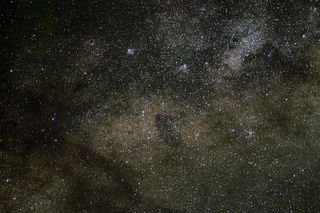
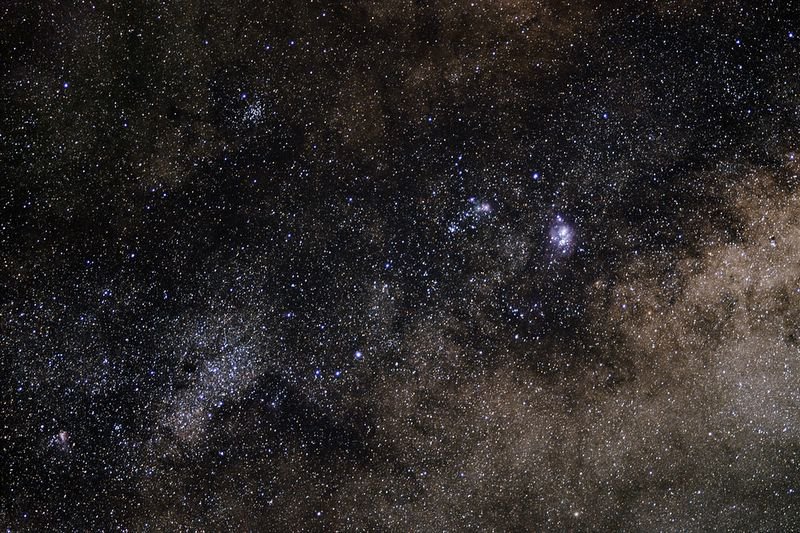
The picture below (which you can click on) is a view a little north of the Sagitarius teapot asterism. A little above the middle of the picture, the two pinkish blobs are M16 towards the left and M17 to the right. There are lots of other named star clusters visible here too. The big whitish star cloud towards the top right in this picture will be towards the lower left part of the next picture, which is looking a little more south and west than this one.
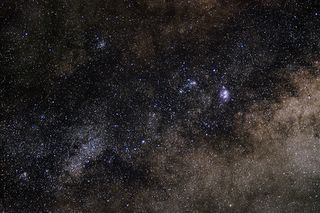
In the picture below, at the lower left you can still see M17, the Omega Nebula, and the whitish star cloud from the previous picture. Plus, a little right of center, you can see two more pinkish blobs. M6, the Trifid nebula, is on the left. and M7. the Lagoon nebula on the right. I also shot a closeup of these two objects, but it is a little blurry. I'll try again next month. At the lower right of this picture, you can see part of the Sagitarius star clouds, the brightest section of the Milky Way. The next picture is somewhat east or up from the right part of this picture.
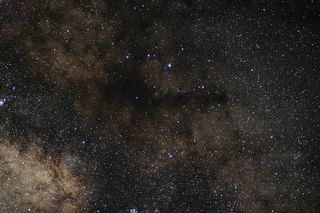
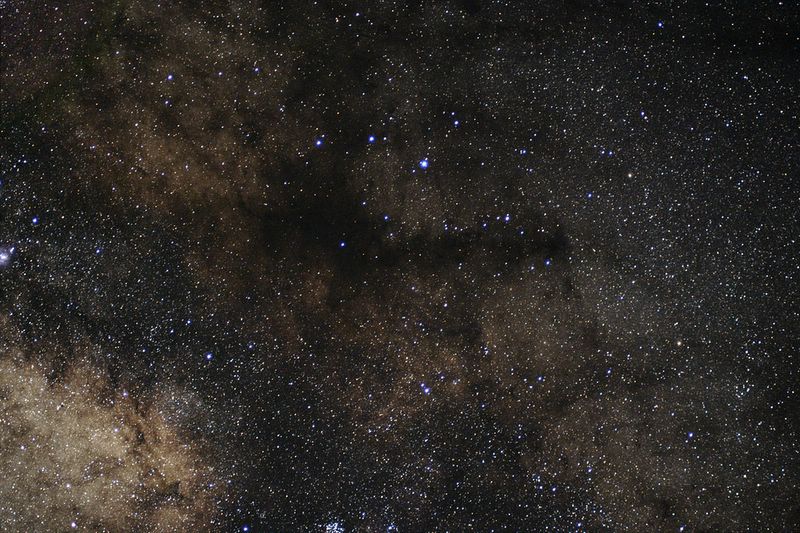
At the lower left corner of the picture below is part of the Sagitarius star clouds seen in the previous picture. Also, halfway up left edge of this picture you can still see the Lagoon Nebula, I think. I took this picture to show that big dark nebula. It was quite noticeable with the naked eye last night. (as was the coal sack by the Southern Cross)
At the middle of the bottom edge of this picture, I think you can see part of the open cluster M6. I have a nice picture of M6 and M7 that I'll post later. (which means that it will eventually be found higher up on my blog page than this posting - confusing I know)
Next month, I'm planning to shoot some wide angle views of the Milky Way with a 28mm lens, assuming we get any clear dark nights. This month I shot more "zoomed in" views with a 100mm lens.
I also took some pictures of objects that weren't near the Milky Way. I'll have to post one of them soon, so you can see how relatively few stars there are away from the Milky Way, even using the same exposure and settings.
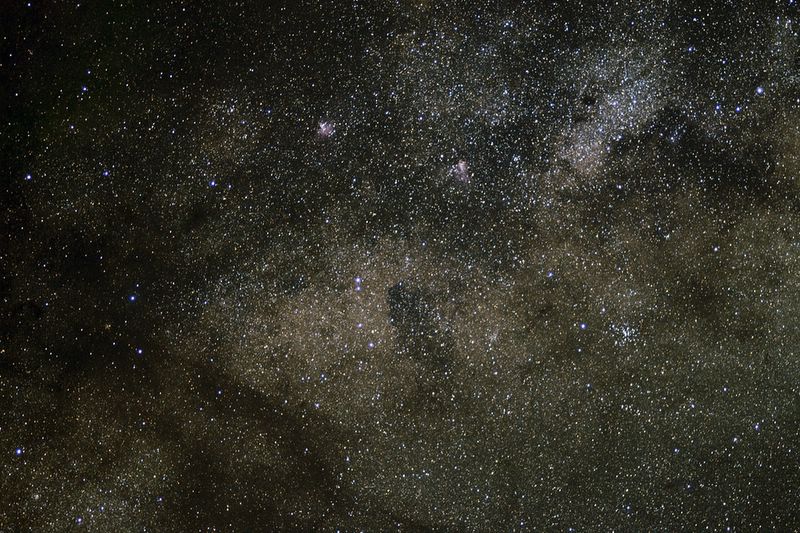
The picture below (which you can click on) is a view a little north of the Sagitarius teapot asterism. A little above the middle of the picture, the two pinkish blobs are M16 towards the left and M17 to the right. There are lots of other named star clusters visible here too. The big whitish star cloud towards the top right in this picture will be towards the lower left part of the next picture, which is looking a little more south and west than this one.
In the picture below, at the lower left you can still see M17, the Omega Nebula, and the whitish star cloud from the previous picture. Plus, a little right of center, you can see two more pinkish blobs. M6, the Trifid nebula, is on the left. and M7. the Lagoon nebula on the right. I also shot a closeup of these two objects, but it is a little blurry. I'll try again next month. At the lower right of this picture, you can see part of the Sagitarius star clouds, the brightest section of the Milky Way. The next picture is somewhat east or up from the right part of this picture.
At the lower left corner of the picture below is part of the Sagitarius star clouds seen in the previous picture. Also, halfway up left edge of this picture you can still see the Lagoon Nebula, I think. I took this picture to show that big dark nebula. It was quite noticeable with the naked eye last night. (as was the coal sack by the Southern Cross)
At the middle of the bottom edge of this picture, I think you can see part of the open cluster M6. I have a nice picture of M6 and M7 that I'll post later. (which means that it will eventually be found higher up on my blog page than this posting - confusing I know)

Friday, June 23, 2006
Southern Cross II

The sky was pretty clear Wednesday evening so I zoomed out to the Sorobon road to try out a new star gazing spot. I got all set up and as my first five minute exposure was ending, the clouds came rolling in. I hung around for a good while, to no avail.
There will be a few more evenings of dark skies before the moon makes its monthly appearance, so I'm ever hopeful. I happened to look out the window at 5:30 this morning and saw nice pink accents in the still dark sky, and a thin crescent moon and Venus shining brightly. I thought of waking up Sandra to see it and then thought better of that. :)
I've posted my Wednesday night picture of the Southern Cross. I didn't process it as much as the picture I posted the other day, so it looks more realistic to me. The dark area to the lower left of the cross is called the Coal Sack dark nebula. It consists of interstellar dust type stuff that hides the stars behind it.
Sunday, June 18, 2006
Southern Cross

I went out to a dark part of Bonaire Friday evening to get a better picture of the beehive cluster with Saturn and Mars. I'll probably do my next beehive post soon. We got clouded out last nigh, when Saturn and Mars were closest together. arrrrrrg!
I also shot a few images of the Southern Cross on Friday. The one posted here is a combination of three exposures at ranging from 1'49" to 2'49", with a 100mm lens at f2.8 and ISO 400. I know I've seen darker, clearer nights here on Bonaire, and I'm still learning about the camera, so I'll revisit the Southern Cross when I get chance.
I'm also eagerly anticipating seeing what sort of images I can get of the summer milky way through Scorpius, Sagitarius, and Scutum in a month or two.
Click on the picture to see a larger but hopefully not too large version
Thursday, June 15, 2006
Astronomy Time
Well, the full moon has come and gone, so the next two weeks or so will be great for enjoying the starry skies of Bonaire. You don't even need a telescope or binoculars to see some really great stuff this month. The Southern Cross is high in the south as soon as it is dark, AND Mercury, Saturn, and Mars are putting on a great show in the west.
You won't be able to see the Southern Cross if you live up north, of course, but you can see the Mercury, Mars and Saturn show pretty much anywhere that has an unobstructed view of the western horizon.
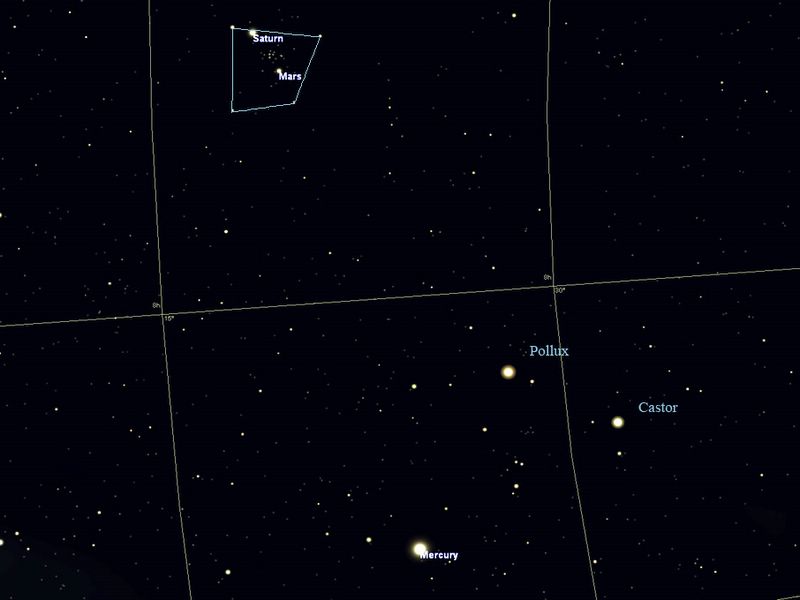
Mercury and the stars Castor and Pollux, the Gemini twins, make a bright triangle low in the west northwest as soon as it gets dark. They were very easy to see here on Bonaire, even though it has been pretty hazy lately.
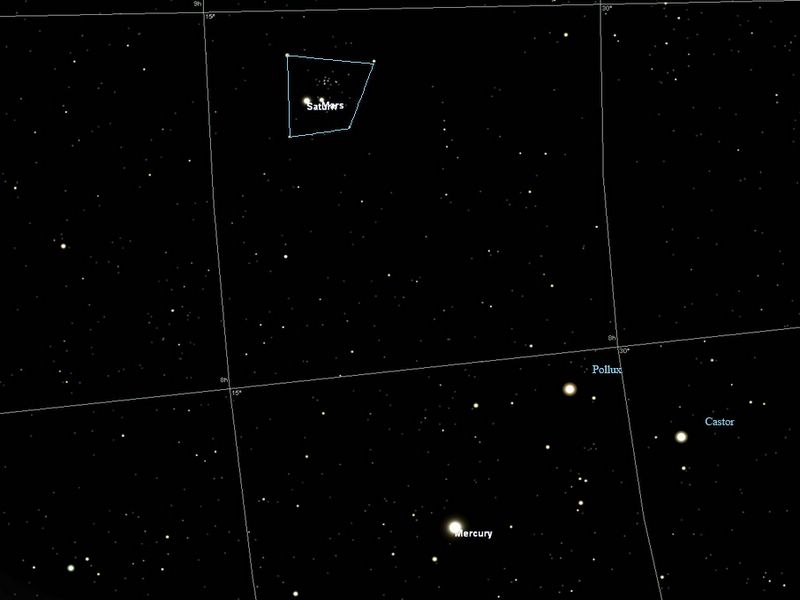
Saturn and Mars are to the upper left of this Mercury, Castor and Pollux triangle. Saturn has been dancing around the Beehive Cluster since last year. (see my posts of Dec. 28 and March 15) Now Mars has joined in the fun. These two planets will be very close together this Saturday evening, June 17. You can watch their positions change each night between now and then, and even into next week.
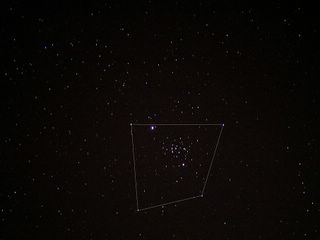
The first picture below is a 15 second exposure I shot last night. If you click on the picture to make it bigger, you'll see that the stars "moved" during the short time that the shutter was open. That's why a telescope needs a motor drive to be able to track the stars as the earth rotates.
Saturn is the bright "star" near the top left corner of the "square". Mars is located just to the right of the middle of the square. Because the Beehive is in the west now, it looks upside down and backwards, compared to the pictures I posted back on March 15, when it was in the east.
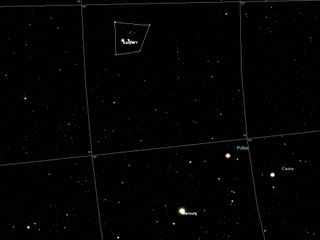
Here is a computer simulation of what I saw Wed. evening. It shows where the planets are in relation to each other.

Here is what it will look like on Saturday evening. Notice how Saturn and Mars have moved closer together. You can click on these pictures to see them better. They aren't too big, so they should load pretty quickly for you.
You won't be able to see the Southern Cross if you live up north, of course, but you can see the Mercury, Mars and Saturn show pretty much anywhere that has an unobstructed view of the western horizon.
Mercury and the stars Castor and Pollux, the Gemini twins, make a bright triangle low in the west northwest as soon as it gets dark. They were very easy to see here on Bonaire, even though it has been pretty hazy lately.
Saturn and Mars are to the upper left of this Mercury, Castor and Pollux triangle. Saturn has been dancing around the Beehive Cluster since last year. (see my posts of Dec. 28 and March 15) Now Mars has joined in the fun. These two planets will be very close together this Saturday evening, June 17. You can watch their positions change each night between now and then, and even into next week.
The first picture below is a 15 second exposure I shot last night. If you click on the picture to make it bigger, you'll see that the stars "moved" during the short time that the shutter was open. That's why a telescope needs a motor drive to be able to track the stars as the earth rotates.
Saturn is the bright "star" near the top left corner of the "square". Mars is located just to the right of the middle of the square. Because the Beehive is in the west now, it looks upside down and backwards, compared to the pictures I posted back on March 15, when it was in the east.

Here is a computer simulation of what I saw Wed. evening. It shows where the planets are in relation to each other.
Here is what it will look like on Saturday evening. Notice how Saturn and Mars have moved closer together. You can click on these pictures to see them better. They aren't too big, so they should load pretty quickly for you.
Tuesday, June 13, 2006
Coral Rocks of Bonaire
Back on June 3, I posted some pictures of the cool rocks we have found on our hill climbing expeditions here on Bonaire. Those rocks are special because most of the rest of Bonaire is made up of fossilized coral reefs.
The weathered grey hills and eroded ground here on Bonaire look like lava rock to me (having never seen real lava, of course) but it's calcium, as you can see when you break off a piece and see its white underbelly.
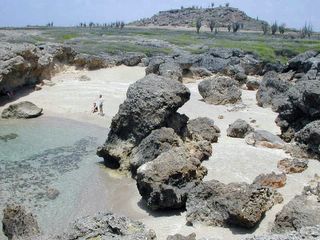
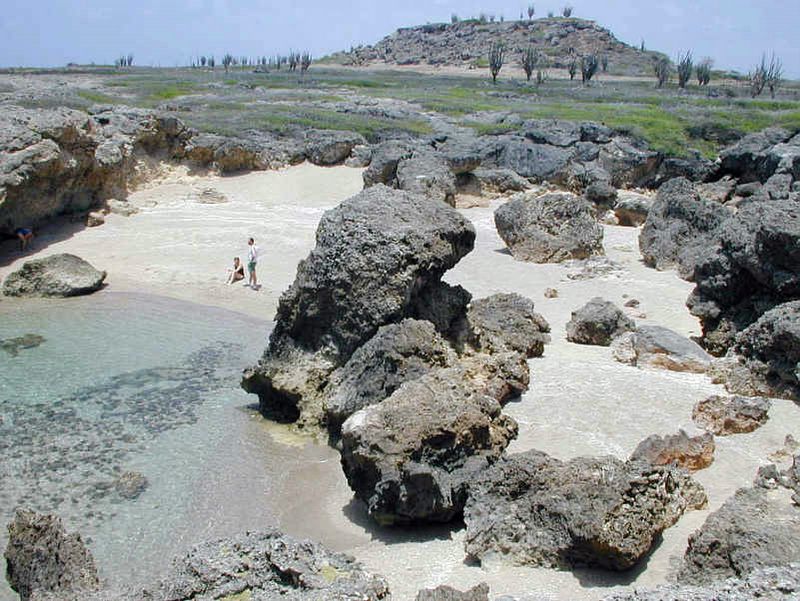
Here is a shot of Boka Kokalishi, in Washington Park, showing lots of grey rock, both in the foreground and in the background.
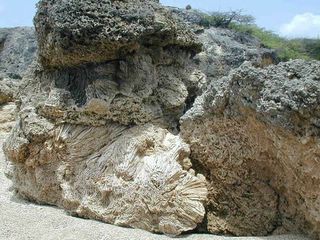
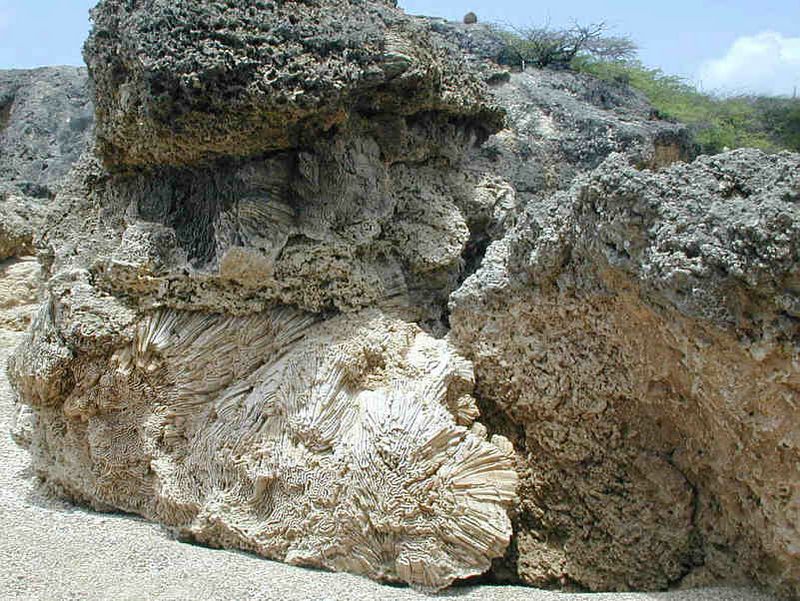
Here is a closer look at one of the rock outcrops in the first photo, showing that it is really a chunk of coral reef.
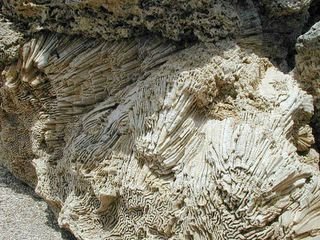
A close up shot, showing some of the cool detail you can see in the coral rocks of Bonaire.
The weathered grey hills and eroded ground here on Bonaire look like lava rock to me (having never seen real lava, of course) but it's calcium, as you can see when you break off a piece and see its white underbelly.
Here is a shot of Boka Kokalishi, in Washington Park, showing lots of grey rock, both in the foreground and in the background.
Here is a closer look at one of the rock outcrops in the first photo, showing that it is really a chunk of coral reef.
A close up shot, showing some of the cool detail you can see in the coral rocks of Bonaire.

Big Bird
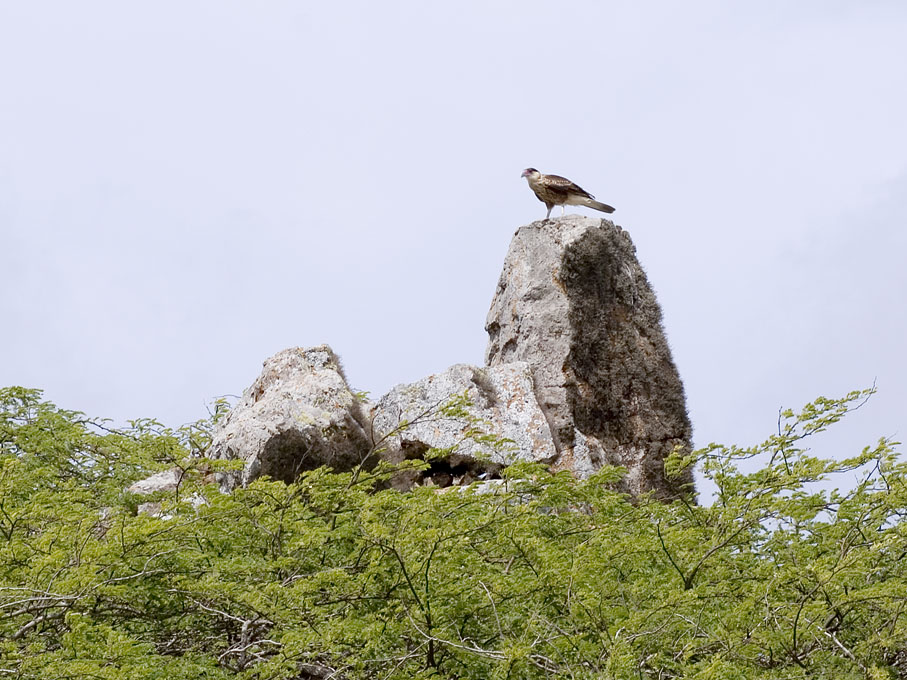
I've been climbing the various tall hills in Washington Park on Saturday mornings. The erosion and breakup of the different types of rock makes them very interesting to observe and somewhat treacherous to climb. Many of the hills have bare rock pillars projecting from their tops.
I often see evidence that hawk type birds hang out on these natural perches. Occasionally I have seen birds up there too. This past week I encountered a self confident one that let me take his picture.
I've carried a 100mm lens the last few weeks, because it is pretty compact, but I'm going to go back to taking a big heavy zoom lens. The 100mm is proving to be too long for panoramas, yet too short to get great bird shots when the occasion presents itself.
This photo is a full scale crop of the original frame. This bird looks similar to the Warawara in my bird book, but not exactly the same, so I'm not sure what it is.
Monday, June 12, 2006
Kibrahacha Trees, take 3
We had a little rain last week. It was enough to fill up our septic tank again... aren't you glad I shared that?
It was also enough to induce the Kibrahacha trees around Rincon to pop. This is the third batch of Kibrahacha trees to do their thing this year. Some years they all do it at once, but I like it better this way.
A bunch of trees in Washington Park were also flowering. I think this is the first time I've ever seen the Kibrahacha trees in the park. I took a panoramic picture from the top of Seru Largu, the hill I climbed this week. I've been riding in the park and climbing one hill each Saturday, but haven't been posting pictures because it is too hazy this time of year. There are a couple hills I'll revisit some day when we have super clear skies.
I put the Washington Park Kibrahacha trees on my club photo site with a photo I called, "kibrahachapano." The thumbnail is at the lower right corner of the web page, at least until I post more pictures. The cool hills to the west of Yuwa pass are at the right side of the picture. You can see the roller coaster cement hill section of the main park road, towards the middle left of the picture, and Rincon off in the haze towards the top of the picture.
It was also enough to induce the Kibrahacha trees around Rincon to pop. This is the third batch of Kibrahacha trees to do their thing this year. Some years they all do it at once, but I like it better this way.
A bunch of trees in Washington Park were also flowering. I think this is the first time I've ever seen the Kibrahacha trees in the park. I took a panoramic picture from the top of Seru Largu, the hill I climbed this week. I've been riding in the park and climbing one hill each Saturday, but haven't been posting pictures because it is too hazy this time of year. There are a couple hills I'll revisit some day when we have super clear skies.
I put the Washington Park Kibrahacha trees on my club photo site with a photo I called, "kibrahachapano." The thumbnail is at the lower right corner of the web page, at least until I post more pictures. The cool hills to the west of Yuwa pass are at the right side of the picture. You can see the roller coaster cement hill section of the main park road, towards the middle left of the picture, and Rincon off in the haze towards the top of the picture.
Bill Early Back on the Air
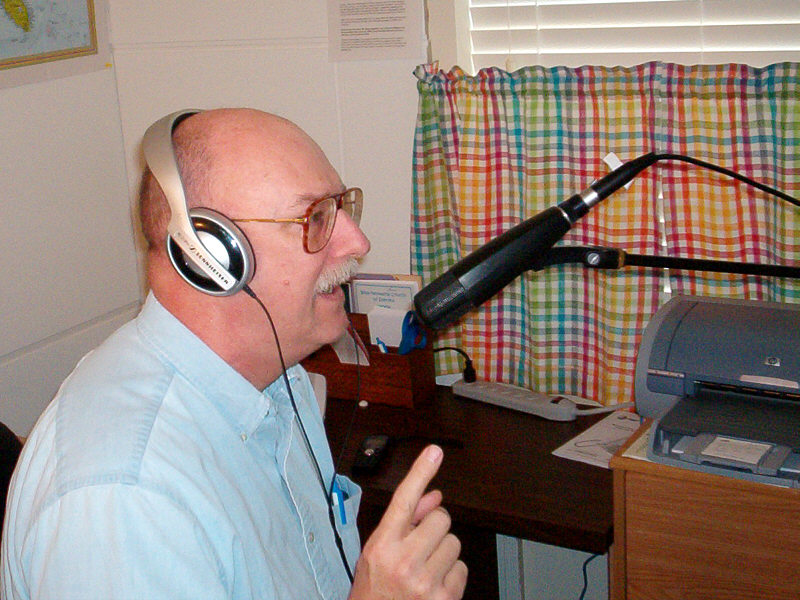
Long time listeners to Trans World Radio - Bonaire still ask us about some of the people that they used to hear on the air. Radio is a form of mass media from our transmitting side, but when seen from the receiving side, individual listeners form very strong bonds with the radio hosts that they listen to night after night.
After an absence of many years, Bill Early is back on the air, seven nights a week, hosting our evening English language programming from 10pm to Midnight. A number of listeners have already contacted us telling us how glad they are to hear Bill again.
Although our listeners assume that Bill is living on Bonaire again, he's actually still in Pennsylvania, representing TWR regionally, and also doing creative scriptwriting work for our worldwide ministry.
Here's how it works. I make notes about each program, when I listen to it a week or more before it is scheduled to be on the air. Those notes get emailed to Bill, he records his chatty voice bits about the programs, I download them from TWR's ftp site, and our handy dandy automation system puts it all together on the air. Well, that's the gist of it anyway.
Bill, together with Joanna Bernhart, who also used to live here on Bonaire, is also corresponding with and counseling our listeners as they email us or write to us in response to our programs. So international radio can be a pretty personal means of communication in some cases.
Saturday, June 03, 2006
Real Rocks of Bonaire
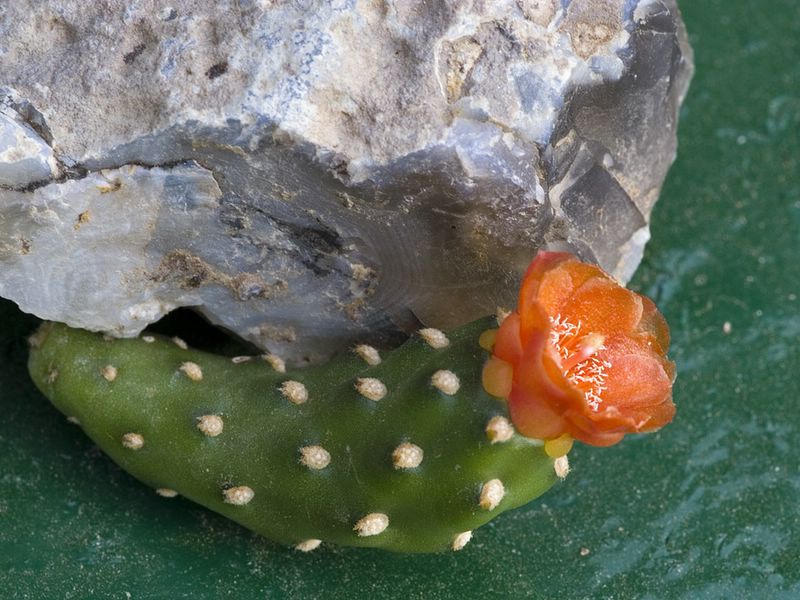
We have a spineless cactus in our planter by the driveway. It has these nice flowers from time to time.
If I ever get tired of climbing the various hills on Bonaire to check out the view and to take pictures, I'll still want to do it to see the cool rocks that are out there. Most of Bonaire is coral, but these hills are often made up of "real" rock.
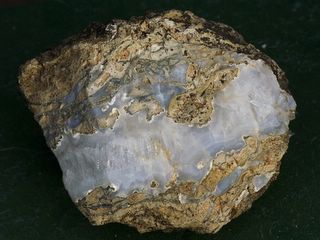
Some of the rocks show banding like this one. They often split along these layers. I have a bunch more pictures of cool rocks from Bonaire on my club photo site, if you would like to check them out.

If I ever get tired of climbing the various hills on Bonaire to check out the view and to take pictures, I'll still want to do it to see the cool rocks that are out there. Most of Bonaire is coral, but these hills are often made up of "real" rock.

Some of the rocks show banding like this one. They often split along these layers. I have a bunch more pictures of cool rocks from Bonaire on my club photo site, if you would like to check them out.

Friday, June 02, 2006
Loras
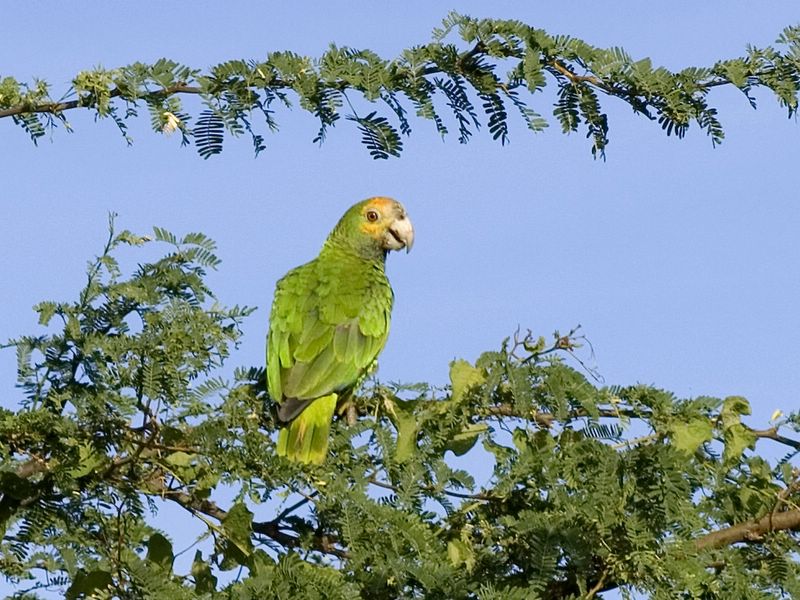
I've seen a bunch of Loras on my bike rides during the last couple days. There have been some around the house too. Loras are much bigger than the Prikichis that we usually see. They are more colorful too.

I'll be on the lookout and try to capture one showing its cool colors. I'll probably put the big zoom lens back on the camera too. This one was aware of my presence, but let me get pretty close with an 100mm prime, and then I cropped the image like crazy. I wish flamingos were this trusting!
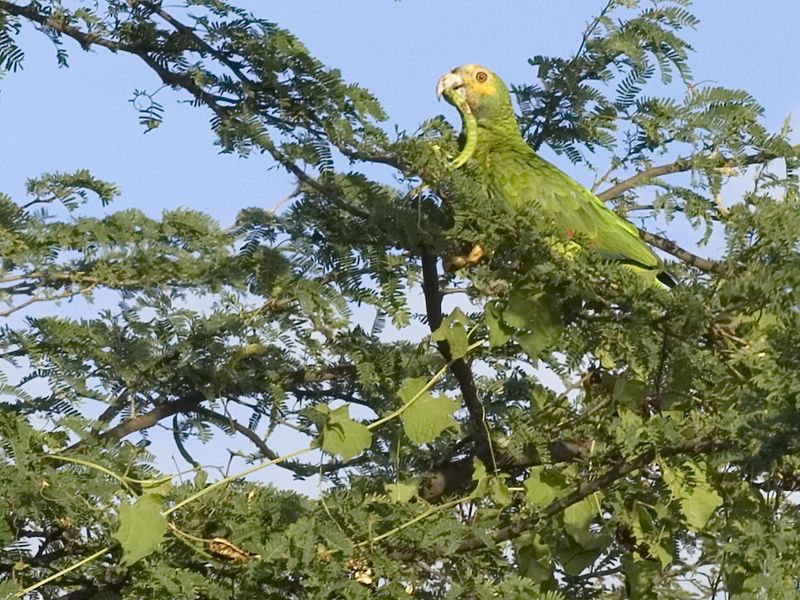
I'll be on the lookout and try to capture one showing its cool colors. I'll probably put the big zoom lens back on the camera too. This one was aware of my presence, but let me get pretty close with an 100mm prime, and then I cropped the image like crazy. I wish flamingos were this trusting!
Sunday, May 28, 2006
Our House
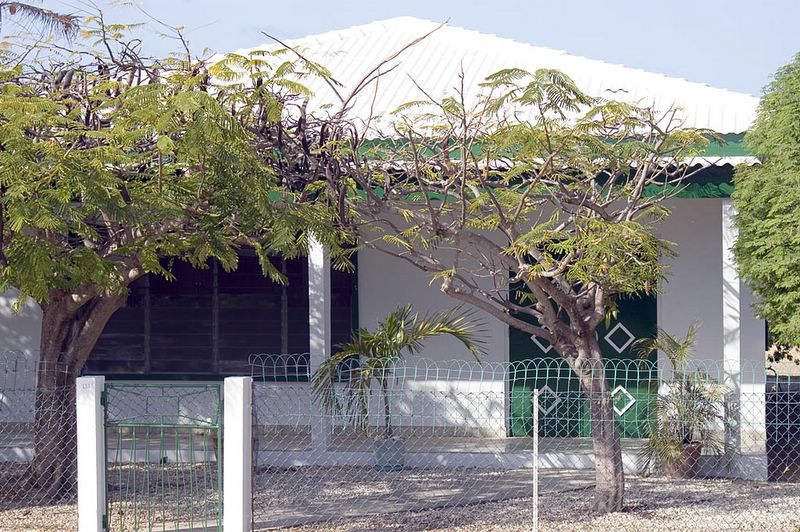
Ivan, Benny, and Udo painted our house last week. It hadn't been painted since before we moved in six or so years ago and was looking pretty faded. Now it is looking fine in a light gray color, with grass green trim.
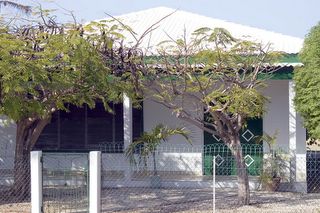
How the guys managed to not get paint all over the very inquisitive dogs is a mystery to me, but they pulled it off.
The tree at the far left is the Wayaká, that was blooming recently. The two trees in the middle are Flamboyant trees. I'm not a fan of this tree, which looks dead most of the year, but the dogs love the huge seed pods. The tree at the right is a Tamarein. It also stays green all year like the Wayaká. I trim it from time to time, so it doesn't look shaggy like it would in the wild.

How the guys managed to not get paint all over the very inquisitive dogs is a mystery to me, but they pulled it off.
The tree at the far left is the Wayaká, that was blooming recently. The two trees in the middle are Flamboyant trees. I'm not a fan of this tree, which looks dead most of the year, but the dogs love the huge seed pods. The tree at the right is a Tamarein. It also stays green all year like the Wayaká. I trim it from time to time, so it doesn't look shaggy like it would in the wild.

More Interesting Bonaire Vegetation
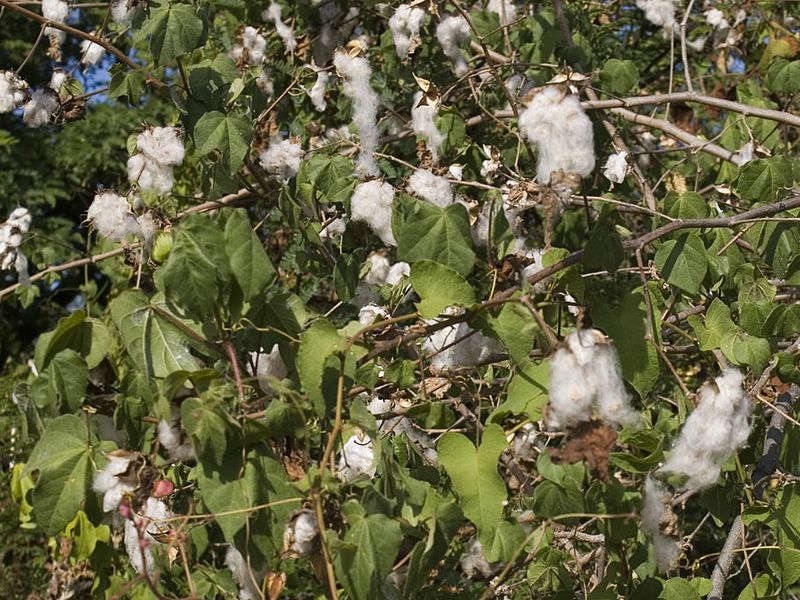
I've posted pictures of a number of the different flowering trees and bushes. Here is another interesting bushy type plant that is making its presence known these days. This cotton type bush seems very hardy and quickly fills in the space when other bushes are cut back. I'm not sure where it came from and if it has any useful purpose or not.
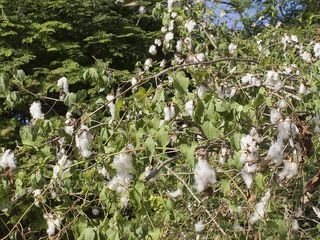
There are a bunch of these plants along the road just north of Hato, and then seem to be spreading like crazy near our house too. I think I'd call it more of a weed than a plant or tree.


There are a bunch of these plants along the road just north of Hato, and then seem to be spreading like crazy near our house too. I think I'd call it more of a weed than a plant or tree.
Thursday, May 25, 2006
Holiday Today
Today is Ascention Day, a holiday here on Bonaire. We took advantage of the day to go to the office to catch up on some non-work work this morning.
We sent off our latest quarterly report / prayer letter to the TWR office in North Carolina. The team there will be sending it out by snail mail in a week or so. If you would like a sneak preview, or if you aren't on our mailing list, email me and I'll send you a PDF version.
I also mixed and mastered a bunch of music that I had recorded a few weeks ago. Our recording studio is a school room now, but we went in on a Saturday, armed with a couple mics, a small mixer and a USB sound card for my laptop. There are 11 piano tracks, and 26 songs/hymns with piano and two singers. It isn't exactly hit parade stuff, but will get lots of use during the various services and small group meetings at the evangelical church in Rincon.
We sent off our latest quarterly report / prayer letter to the TWR office in North Carolina. The team there will be sending it out by snail mail in a week or so. If you would like a sneak preview, or if you aren't on our mailing list, email me and I'll send you a PDF version.
I also mixed and mastered a bunch of music that I had recorded a few weeks ago. Our recording studio is a school room now, but we went in on a Saturday, armed with a couple mics, a small mixer and a USB sound card for my laptop. There are 11 piano tracks, and 26 songs/hymns with piano and two singers. It isn't exactly hit parade stuff, but will get lots of use during the various services and small group meetings at the evangelical church in Rincon.
Dog Days
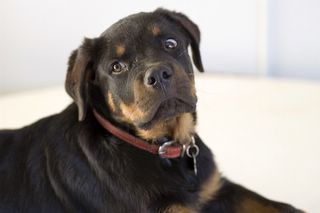
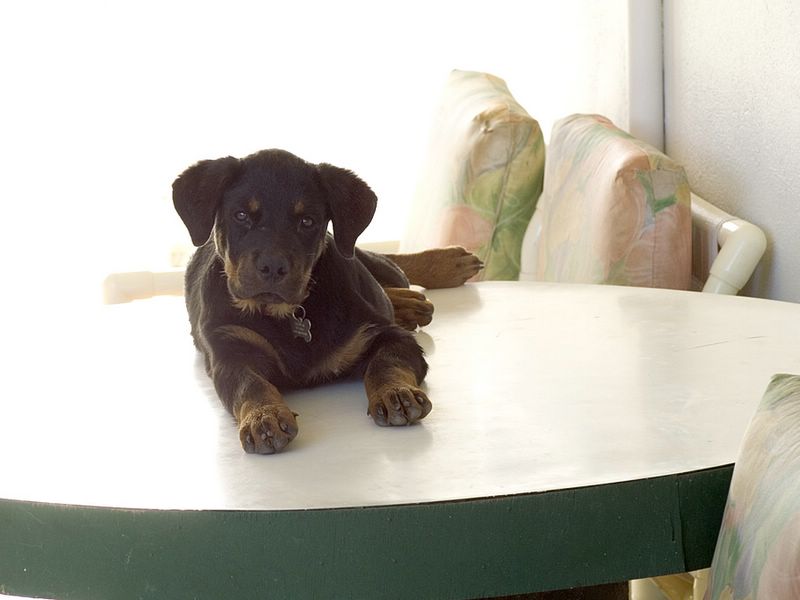
May 25 will go down in Swanson dog history as a red letter day for one of our dogs and as a day of infamy for another. The puppy has figured out how to get onto the table in the carport.
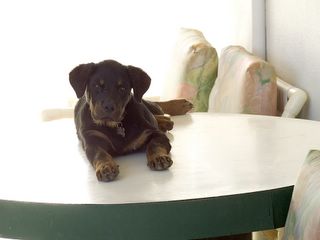
Said table was the last remaining refuge for this dog, when she needed an escape from crazed puppy antics. Hence the woebegone look you see below.
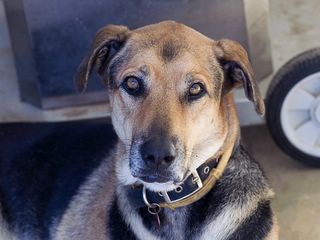
Can you guess who the puppy is looking at? It's not me obviously! Later in the morning, we turned the tables on the pup by moving the chairs so he couldn't use them to hippity hop his way onto the table top.
The other dog can easily hop up from ground level to gain access to that all important sanctuary. But, the biological clock is ticking, and it's only a matter of time until the pup regains that all important table top access.
Said table was the last remaining refuge for this dog, when she needed an escape from crazed puppy antics. Hence the woebegone look you see below.

Can you guess who the puppy is looking at? It's not me obviously! Later in the morning, we turned the tables on the pup by moving the chairs so he couldn't use them to hippity hop his way onto the table top.
The other dog can easily hop up from ground level to gain access to that all important sanctuary. But, the biological clock is ticking, and it's only a matter of time until the pup regains that all important table top access.

Wednesday, May 17, 2006
This week's Blooming Trees.
About a week ago, I posted some pictures of the Brazil wood trees in bloom. Here are a couple other trees that are beautifying Bonaire these days.
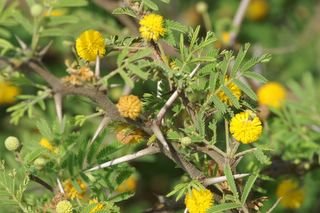
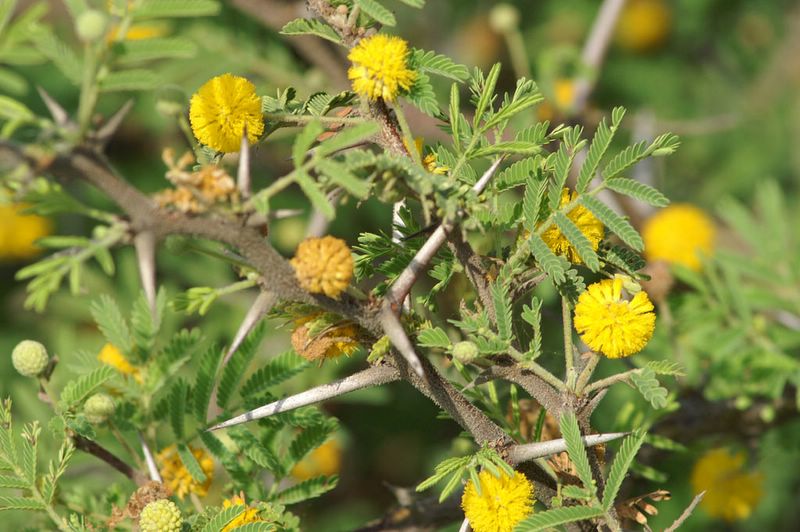
The Wabi, a type of Acacia, was blooming back a couple weeks ago.
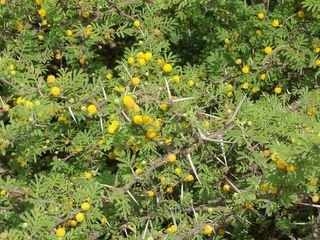
I find it interesting that such a nasty bush/tree has a pretty phase.
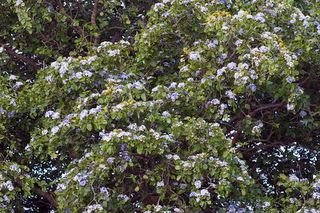
The Wayaka in front of our house is blooming like crazy this week. There are lots of bees buzzing around it too. This tree is pretty large. We have some smaller Wayaka(s) on the side of the house and in the back, but they don't flower as I recall. They do stay green year round, which is great.
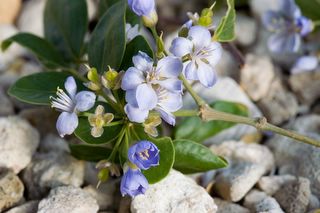
There is a fruit of sorts that appears after these flowers. It is kind of pretty too. We've seen humming birds around this tree in the past, but not yet this year.
The Wabi, a type of Acacia, was blooming back a couple weeks ago.

I find it interesting that such a nasty bush/tree has a pretty phase.
The Wayaka in front of our house is blooming like crazy this week. There are lots of bees buzzing around it too. This tree is pretty large. We have some smaller Wayaka(s) on the side of the house and in the back, but they don't flower as I recall. They do stay green year round, which is great.

There is a fruit of sorts that appears after these flowers. It is kind of pretty too. We've seen humming birds around this tree in the past, but not yet this year.

Friday, May 12, 2006
TWR Joint Americas Staff Meeting
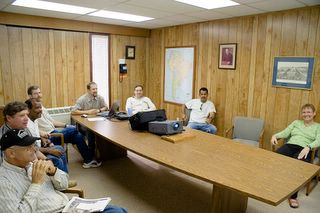
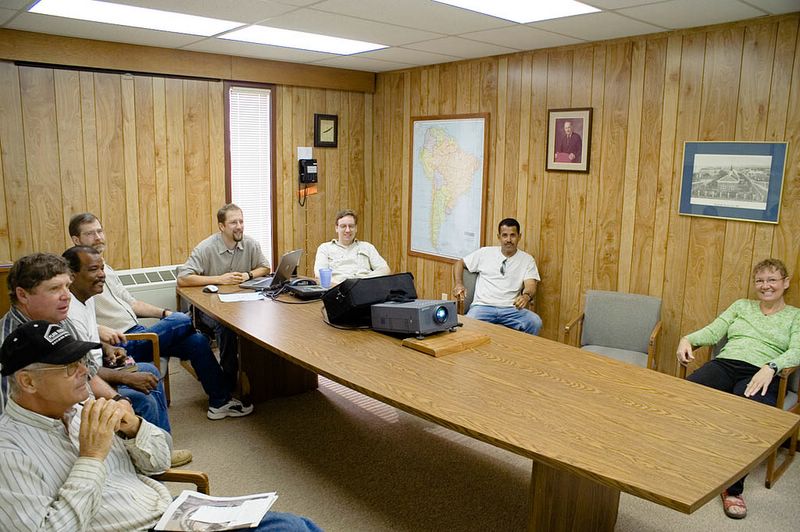
Yesterday we had a joint staff meeting with our co-workers at the TWR office in Cary, NC. It was a lot of fun, as you can see from our smiling faces. We used one of our internet connections and an IP speakerphone for the two way audio, and our other Internet connection for a shared "white board" session.
We could both see this white board, which was covered with yellow post it notes by the end of the meeting.
Here is how our director, Joe Barker, describes it. "Bonaire and Cary held a joint staff meeting, with Lemuel Larrosa and Ann Chastain joining us remotely. What did we accomplish? We threw up ideas on the screen that expressed components of our purpose in TWR. From our role, in our corner, we contributed words that express our purpose within the big picture of the Americas region of TWR."
We'll be refining these ideas and thoughts during the next few weeks.
We could both see this white board, which was covered with yellow post it notes by the end of the meeting.
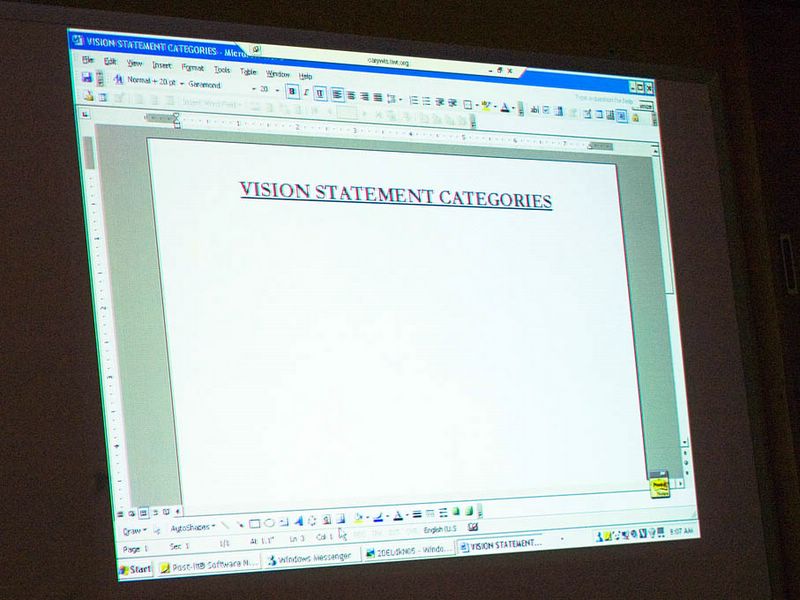
Here is how our director, Joe Barker, describes it. "Bonaire and Cary held a joint staff meeting, with Lemuel Larrosa and Ann Chastain joining us remotely. What did we accomplish? We threw up ideas on the screen that expressed components of our purpose in TWR. From our role, in our corner, we contributed words that express our purpose within the big picture of the Americas region of TWR."
We'll be refining these ideas and thoughts during the next few weeks.
Thursday, May 11, 2006
Hotel Bonaire Rubble

A crew has started clearing away the rubble across the street from our offices and studios. They are using one loader and two dump trucks so it is going to take a while.
But it is looking nicer over there already.
Wednesday, May 10, 2006
Washington Park Photo Safari
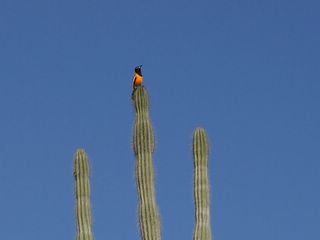
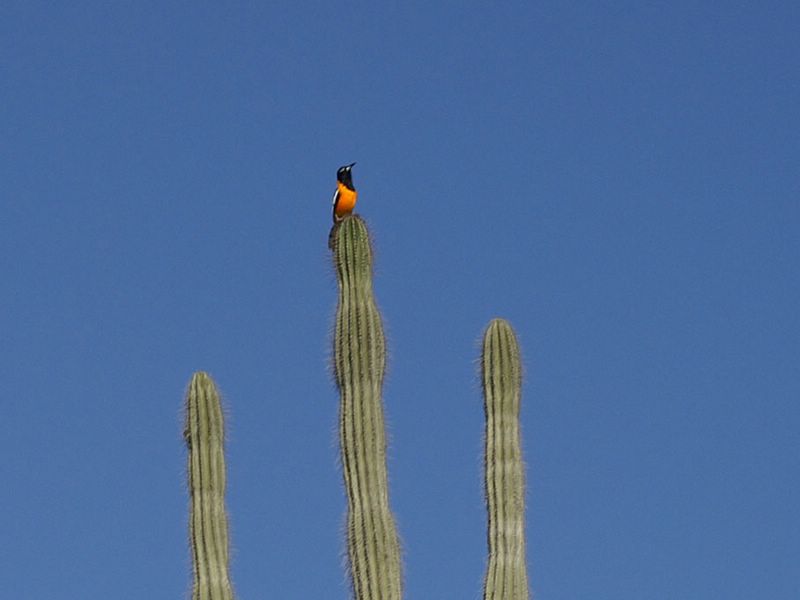
Sandra and I drove through Washington Park back on April 29, and climbed a couple hills. We saw this Trupial sitting on top of a cactus.
I also took some pictures of the flamingos in the salt flats on your right near the park entrance. It is on my club photo site and is called "flamingopan."
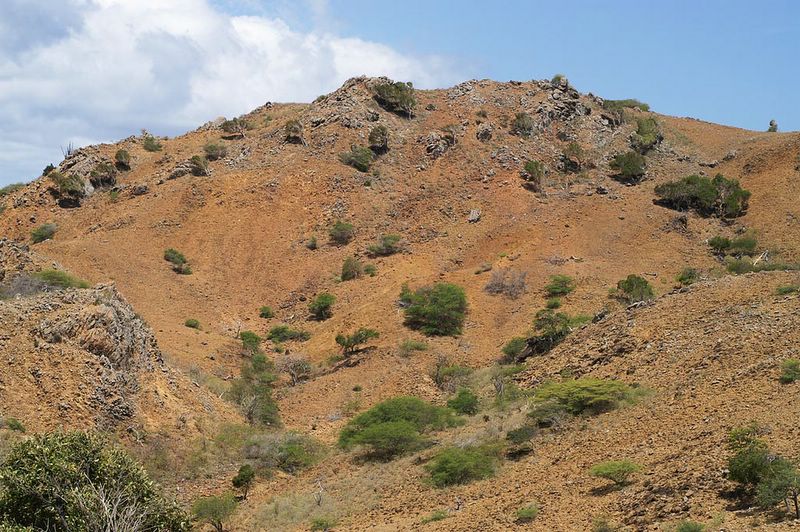
One of the hills we climbed was to the west of the road, at the top of Yuwa pass.
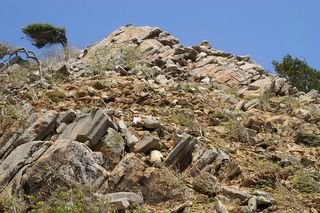
We'll be back to this area, because it is so different from almost anywhere else on Bonaire.
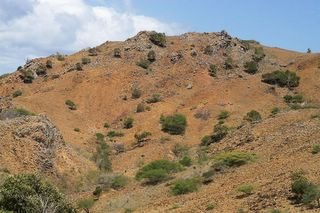
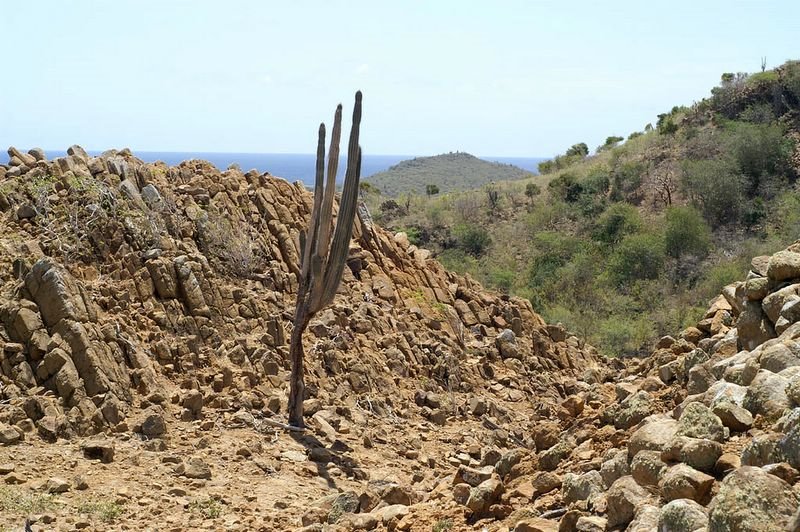
Many of the rocks seem to have formed into giant crystals of some sort, and are breaking apart in big chunks.
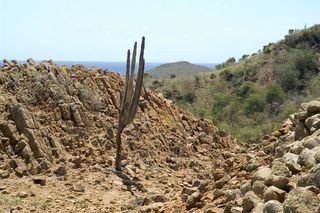
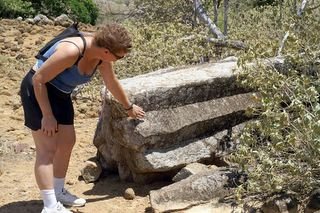
Here is a really cool chunk that has fallen off of an outcropping.
I also took some pictures of the flamingos in the salt flats on your right near the park entrance. It is on my club photo site and is called "flamingopan."
One of the hills we climbed was to the west of the road, at the top of Yuwa pass.

We'll be back to this area, because it is so different from almost anywhere else on Bonaire.
Many of the rocks seem to have formed into giant crystals of some sort, and are breaking apart in big chunks.
Here is a really cool chunk that has fallen off of an outcropping.

Subscribe to:
Posts (Atom)