We pump out our radio programs, with 100 kilowatts of power, each night here on Bonaire, but don't always hear back from our audience. The emails, calls, and letters go elsewhere. However, we do eventually get to see some of the results of our efforts.
In August, TWR received forty letters from Cuba, in response to the program A Traves de la Biblia. We also received a letter from Las Vegas, from a person who listened to us when he used to live in Cuba.
Here is a translation of one that came from a listener in the Dominican Republic.
Greetings friends…I listen to you daily on 800 kHz AM during hours of night. My joy is great and I benefit spiritually listening each night to your programs in Spanish and I want to tell you that my life has taken a 180 degree turn around. The truth is that you cannot imagine the understanding that your programs have given me and the change that has taken place in me…May God bless you and I am listening to you everyday.
Wednesday, October 31, 2007


Hooray, the Weather is Back to Normal
While some may know October 31 as Halloween, I like to think of it as the last day of the official hurricane season. (oops, Georgina, the director of our Dominican Republic office informs me that the official hurricane season goes to the end of November, not the end of October. I did a Google search, and the NOAA agrees with her! Thank you Georgina.)
Our weather on Bonaire is getting back to normal now that Tropical storm Noel has moved further away. Normal for this time of the year is early morning showers, and then light winds and sunshine during the day. While Noel was dumping rain on Haiti and the Dominican Republic (DR) to our North, we had a week of overcast skies and occasional heavy rains.
Our Trans World Radio team in the DR reports that water has entered part of their new office / studio building and that Noel has created "a national tragedy" in that country. We'll keep those countries in our prayers and we'll remember to be thankful that Bonaire never seems to catch the brunt of these storms.
The skies were clear enough to see comet Holmes the last two evenings. It is very easy to spot, if you know where to look. I snapped a couple pictures last night, but I haven't opened them on the computer yet to see how they look.
Five of us went for an early morning/before work group bike ride today. A lone rain cloud had paid a visit to some of the roads we rode on just before we got there, and they had a soupy sort of muddy texture to them. It was fun actually, but my chain started locking up part way up the back side of Seru Largu, probably because of that mud, grrrrr...
I got myself and the bike cleaned up and still made it to work by 8 am. so all in all, it was a success I think.
Recent Picture Posting Malfunction
I've noticed that in my recent post about the new satellite antenna, I somehow uploaded some large out-of-the-camera jpegs, instead of my downsized, color balanced and curved jpegs. I'm just going to leave it as is, I think, but I do apologize for the over sized and gloomy images.
Monday, October 29, 2007
Big Bonaire Birdbath
Ernie, Benny, and Ivan added another giant bird bath to our collection behind the office wing. This week they'll probably install the gear that turns it into a satellite antenna. Notice the lush grass. It has been raining a lot here this fall. Stuff is growing like crazy, and some of the dirt roads and trails we mountain bike on are getting narrower and narrower as the vegitation expands.
 That all purpose Gradall crane/forklift/cherry picker is fairly new on Bonaire, I think, and sure came in handy on this job.

 Notice the lush grass. It has been raining a lot here this fall. Stuff is growing like crazy, and some of the dirt roads and trails we mountain bike on are getting narrower and narrower as the vegitation expands.
 That all purpose Gradall crane/forklift/cherry picker is fairly new on Bonaire, I think, and sure came in handy on this job.

The guys make a good team don't they.
Thursday, October 25, 2007
Dog Days of October

We've seen a lot of wet and muggy weather this month. Regatta week was rainy and hot. Last week was pretty nice. This week has been very rainy, but not quite so hot.
The puppy is growing like a weed, and hanging out in the nice dry car port. He doesn't look too impressed with his lot in life though.
I shot this photo while doing some camera testing. We're going to be switching from the Minolta/Sony world to Canon. I've pretty much worn out the shutter on my first Maxxum 5D - I have to turn the camera off and back on between each picture. The second camera has never really worked right. The Canons also have some real advantages for astro-photography so it seems to be time for a switcheroo.
My parents have graciously offered to help me sell my collection of wonderful Maxxum lenses on eBay. The good news is that they appear to have appreciated in value since I bought them. Time will tell whether or not the Canon lenses (the ones that I can afford!) will be able to equal the great vintage Minolta glass.
New Bright Comet
There is a weird comet that has just brightened a million-fold over the last couple days. It was magnitude 18 as recently as Oct. 20, but it is now an easy naked eye object in the constellation Perseus.
Our rainy weather here on Bonaire continued today and unfortunately, the sky has been completely clouded over last night and tonight, so I haven't seen it. Aaaarrrrrggggg......
If you know were Perseus is in the sky, you can learn the exact location of the comet here. It sounds like you can't miss it.
Delayed Listener Reaction
Sometimes we hear from our radio listeners right away, by email or on the phone. Other times, many years might go by before we hear from them.
This note, just received at Trans World Radio's office in Cary, North Carolina, is a case in point.
My parents were Wycliffe translators for 45 years in South America. Many times we listened to “church” on your radio station while we were out in the jungle. Thank you for feeding us God’s word while my parents worked to make it available to others!!! Blessings!!!
This is certainly not the first response of this type that we have received to our broadcasts. So for the last eight years or so TWR has been producing radio programs specifically for Missionaries and other NGO cross cultural workers. You can read about this initiative here.
Friday, October 12, 2007
Star Count Update
Back on September 26, I wrote about the Great Worldwide Star Count project. Well, I went out Wednesday evening to see how many stars I could see. From my back yard, I could see all the stars on the Magnitude 5 star chart and a couple of additional stars from the Magnitude 6 star chart. I then drove a just little bit North of Sabadeco on the upper dirt road that goes to the Radio towers overlooking Rincon. The sky was darker there, I could easily see the Milky Way running from the western horizon, up through Cygnus (the Northern Cross) and over to Cassiopia. I could also see most of, but not all, of the stars on the Magnitude 6 star chart.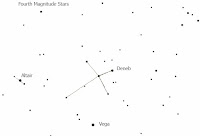 I know the night sky pretty well, but I still found it tricky to match up what I was seeing on the Sky Count star charts with what I was seeing in the sky. So I've taken the liberty of labeling a few of the bright stars and drawing in some constellation lines. These charts might help you out if you want to head out and see how many stars you can spot in Cygnus, the Northern Cross. You can click on them to make them bigger, of cours, and probably print them to use them "in the field" with your red flashlight. I use my bicycle tail light.
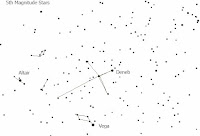 If you like looking at the stars at all, do get outside during the next night or two, before the moon gets bright, and see how many stars you can see from your location. You can figure out your latitude and longitude from Google Maps, and report your findings on the Great Worldwide Star Count website.
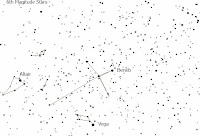 It's not many times one gets to contribute to real science without needing a lot of equipment and training.
Speaking of equipment, I'm still experimenting with getting good star pictures with minimal fuss and equipment. I brought my camera and a regular tripod with me when I headed out to count stars. The picture below, shows the stinger of Scorpius' tail as a vertical pair of stars a little left of center at the bottom edge of the picture, just to the right of a cactus. The teapot of Sagitarius is standing on its spout with the bottom of the teapot on the left and the top of the cap to the right. The spout is a little to the left of the middle of the picture, partway into the Milky Way. The handle is a little down from the top of the image. Half way between the stinger and the spout of the teapot is M7, an open cluster of stars.
 I know the night sky pretty well, but I still found it tricky to match up what I was seeing on the Sky Count star charts with what I was seeing in the sky. So I've taken the liberty of labeling a few of the bright stars and drawing in some constellation lines. These charts might help you out if you want to head out and see how many stars you can spot in Cygnus, the Northern Cross. You can click on them to make them bigger, of cours, and probably print them to use them "in the field" with your red flashlight. I use my bicycle tail light.
 If you like looking at the stars at all, do get outside during the next night or two, before the moon gets bright, and see how many stars you can see from your location. You can figure out your latitude and longitude from Google Maps, and report your findings on the Great Worldwide Star Count website.
 It's not many times one gets to contribute to real science without needing a lot of equipment and training.
Speaking of equipment, I'm still experimenting with getting good star pictures with minimal fuss and equipment. I brought my camera and a regular tripod with me when I headed out to count stars. The picture below, shows the stinger of Scorpius' tail as a vertical pair of stars a little left of center at the bottom edge of the picture, just to the right of a cactus. The teapot of Sagitarius is standing on its spout with the bottom of the teapot on the left and the top of the cap to the right. The spout is a little to the left of the middle of the picture, partway into the Milky Way. The handle is a little down from the top of the image. Half way between the stinger and the spout of the teapot is M7, an open cluster of stars.
 So I mounted the camera on my trusty tripod, used a 28mm lens at f2.8, and took some 15 second and some 8 second exposures at ISO 800. I could pick these exposure times from the camera's menu, so I didn't need a cable release or remote trigger device. When I got home and looked at the pictures at 100% size, I could see that the stars had moved during the 15 second exposures, but they appeared quite round in the 8 second exposures.
Having said all that, it is interesting that the picture here is a combination of three 15 second exposures that I've downsized for easier viewing online. The stars look round enough in this small size image. (well you can hardly see them at all in the thumbnail. I'm really referring to the 1024x768 image you'll see if you click on the thumbnail) The 15 second pictures showed a lot more Milky Way than the 8 second ones, so I used the 15 second images, and downsized them.
So, if you have a DSLR and happen to be somewhere where you can really see the stars, have a go at taking a picture or two, even if you have to prop up the camera with a rock on the roof of your car and use the self timer to trigger the shot. You won't get a prize winning photo, but you might be surprised by what you can see in that image. I shot some 8 second images of Cygnus while I was out star counting and they showed MANY more stars than I could see with my naked eye. I'm still snooping around Bonaire for a great foreground of cacti, in front of a non light polluted western horizon. I can find one or the other, but not both.... so far.
7th Annual Jong Bonaire Swim
There are loads of fun outdoor events here on Bonaire this fall. This week is Regatta week, and the 40th annual Bonaire sailing regatta is winding down today and tomorrow. And yes, we've had our annual rainy and windless weather this week as well. October and November also see a long distance swim event, running races, a couple of big cycling tours, as well as a mtn. bike race.
 The seventh annual swim to Klein Bonaire, to benefit Jong Bonaire, was held this past Sunday. Loads of people turned out for this worthy cause, and a chance make the swim between Bonaire and Klein Bonaire in safety.
 I had to head over to our church at 8am, to set up the PA system, and missed the start of the actual swim. George DeSalvo sent me this action photo of the swimmers getting underway.
Sunday, October 07, 2007
Moon and Planet Show
 Shortly before dawn today, Venus, Saturn, the Moon and the bright star Regulus made a nice compact grouping in the Eastern sky.
Regulus is the brightest star in the constellation Leo.
On Tuesday morning, October 9, the moon will have moved down to the horizon, but Venus, Saturn and Regulus will assume their most compact grouping. They'll fit within a circle 4.5 degrees across and could be viewed together in many binoculars.
Tuesday, October 02, 2007
ISS Update
 Well, Sandra and I zoomed to the south end of Bonaire yesterday evening. Jupiter was about 52 degrees left (south) of the sun and about 48 degrees high when the sun set at 6:23 or so.
We didn't spot Jupiter right away, but by 6:34 or so, it was very easy to see. By 6:43, when the International Space Station came floating by, the sky was dark enough to see the star Antares. The ISS and Jupiter were quite bright.
It turns out that we were not in precisely the exact spot we needed to be in to see the ISS appear to hit Jupiter. We should have been a tiny bit further South. But it was still a fun exercise.
The photo shows the full frame of a four second exposure that I made with an 100mm lens. You'll probably have to click on it to be able to see Jupiter.
Monday, October 01, 2007
Space Station Double Header Today
 The International Space Station (ISS) is putting on a great show for us here on Bonaire today.
This morning at 05:39, it passed right in front of the Moon, as seen from near the Trans World Radio transmitter site.
Tonight, at 18:43, the ISS will pass right in front of Jupiter. It won't be dark here on Bonaire, at 18:43, but Jupiter and the ISS are pretty bright, so I'm hoping that I'll be able to see this.
The place to be to see this event is on the road that goes around the south end of Bonaire, between Red Slave and the Fishing Hut/Kitesailing area. (closer to the fishing hut than red slave) I'll double check the ISS orbital elements this afternoon and try to position myself in the exact right spot. From what I've been able to figure out online and with the SkyMap Pro planetarium software, one has to be within about plus or minus 50 meters of the sweet spot in order for the ISS to appear to "hit" Jupiter.
If you happen to be on Bonaire, look for my white Samurai, and you can help me look for Jupiter in the twilight, and then we'll wait and see if I've nailed the location or not. I'm going to double check the coordinates this afternoon, with the most recent set of ISS orbital elements. As of right now, the place to be is 12.039157 degrees North and 68.263582 degrees West. You can look at it on Google Earth or if you are here on the island, you can try going there following your GPS receiver.
I tried taking a picture of the ISS and moon this am, but in my excitement I must have pushed the remote shutter release button crooked or something and ended up taking the picture just AFTER the ISS passed the moon. grrrrrrr I had fired off a few test shots before hand and the camera triggered quite promptly then. Here is what the moon looked like this am, well.... other than the fact that this picture is upside down! It's 1024x768 so you can use it as desktop wallpaper. I'll probably make it right side up and play with it some more before it ends up on my desktop however.
Saturday, September 29, 2007
30 sec. Milky Way Photo

Some of you have commented on the star and cacti picture I posted on Sept. 21. I'm still scheming as to how I can get a picture with nice crisp cactus silhouettes on it. I could always make a composite picture on the computer, but I'd like to capture a real life image if I can.
I was out in our back yard last night to see an Iridium satellite produce a -6 magnitude flare of reflected sunlight. While I was waiting for the Iridium flare, I pointed my camera to the southwest over our house and Kaya G.N. Debrot and snapped a shot of Jupiter hanging out by Antares and the other bright stars of Scorpius.
I was surprised at how many stars turned up in this 30 second exposure. Now I had to work it over in Photoshop quite a bit, and there is a good deal of digital noise compared to images made up of a stack of longer exposures, but I'm still pleased. That is the roof of our house in the lower right corner, and it isn't that blurred.
So it looks like these settings of 30 seconds, at F2.8 and ISO 400 might also bag me a good cacti and stars picture. I'll have another go at it soon, if I can. Some of the newer cameras produce less noise than mine, so 15 seconds at ISO 800 or even ISO1600 wouldn't be out of the question. It seems to me that a 15 second exposure with a 28mm lens could be made from a stationary tripod instead of sitting on top of a star tracking telescope. Hmmm, Milky Way over Brandaris... that would be a cool picture. :)
That black blob at the bottom of the picture is the tube of the telescope I had the camera sitting on. The big white blob in the upper middle part of the picture is Jupiter. Antares is the bright red star to Jupiter's lower right. A little above the left end of the telescope blob is a pair of stars that make up the stinger of the Scorpion's tail. To their upper left are M6 and M7, a pair of open star clusters.
The spout of the teapot is a little way up on the left edge of the picture. A little above half way up on the left side of the picture are the Lagoon and Triffid Nebula, and some more star clusters can be seen above them on the left edge of the image. The WEB power plant would be just off the left side of this picture.
Satellite Watching

I've enjoyed watching satellites cruising across the vast Bonaire evening skies for more than 30 years now. One advantage of living on a relatively flat desert island is that one can see the sky from horizon to horizon. So satellites, meteors, low lying planets like Mercury are all readily visible.
Sandra and I saw a very bright Iridium flare last night. The Web sites CalSky and Heavens-Above both can predict all sorts of interesting goings on in the sky, once you enter your location. CalSky even sends customizable email alerts. The web sites also list exactly which satellites are visible on any given night, so we no longer have to resign ourselves to saying, "I wonder what satellite that was?"
The International Space Station will be visible here on Bonaire the next few evenings. The right coordination of orbit and sunlight seems to come in bunches. I may have a chance to see the ISS cross the moon as well as Jupiter if I am lucky.
The picture is from last night. An Iridium satellite flared right in the middle of the constellation Cepheus. Cepheus sort of looks like an upside down stick figure of a house. The five main stars are visible from our back yard, as are a few more in the general area. The three minute exposure shows so many stars that I can't figure out the shape of Cepheus, even though I know right where it should be. If it clear tonight, maybe I'll try a short exposure - because another Iridium satellite is going to be flaring in almost the same spot.
Wednesday, September 26, 2007
The Great Worldwide Star Count
Yippie, the moon was full 15 minutes ago, as I write this.... so it is going to rise around sunset tonight and then it will be coming up later and later each night. It's time to dust off the old telescope and hope for cloud free skies during the next two weeks.
If you don't have a telescope, be sure to head outside anyway. In fact, if you are into stargazing at all, and can find the Northern Cross in the Northern Hemisphere, or the Sagitarius Teapot in the Southern Hemisphere, you can contribute to an interesting science project examining the extent of light pollution around the world. Here is a Web page giving an overview of the project.
Here is where you can find out the details of how you can participate any time between October 1 and 15. I think I'll try it in my back yard in Hato and also maybe head out to Boca Onima or some other dark site and see if I can see more stars. Even if you live in a city or some other spot with lots of ambient light, your observations will still provide valuable information.
If any of you do this, how about commenting on this post with your location and results. Thanks.
Tuesday, September 25, 2007
Studio/Office Move in the DR
Joe Barker and Ivan Statia recently travelled from Bonaire, to the Dominican Republic, to help set up a new office and radio production studio for our TWR partner there. It will be a nice birthday present for Radio Trans Mundial Dominicana, which will be celebrating its 20th anniversary on November 11.
The old office and studios were on the middle floor of a three story building that they shared with some rather noisy commercial tenants, like a laundry. The team in the DR often had to come in at all sorts of weird hours in search of peace and quiet to record their radio programs. The new facility is in a converted single family house, which should be much quieter. From left to right in the above photo, you can see Georgina Thompson, the director of RTM-DR, Joe Barker and Ivan Statia-from Bonaire, and Helmut Menzel-TWR's globetrotting design engineer.
They had two weeks to convert the house into an office and studio complex as well as completely move every last computer, document, microphone and paper clip from the old facility to the new one.
 I the above photo, we see Ivan and Joe working on the sound treatment for the walls of the new studio.
 Check out that carpeting on that door. It appears that Joe and Ivan's previous career doing van conversions for hippies in the 70's was perfect preparation for radio studio construction. ha-ha If enough of you ask, I'll post of picture of Ivan from that era.
 Here the control room of the studio is beginning to take on a recognisable form. I hope that air conditioner unit is quiet. The old studio had a fan in it that we could sometimes hear in the background on some of the programs the produced for us to air on Bonaire. I could remove the noise with Adobe Audition, but a quiet room is always better, of course.
 Hooray, it's moving day. The TWR staff, contractors, and volunteers were able to complete the two week project on time. Thank you, Georgina, for sending us these pictures.
By they way TWR's Spanish language Web site has been re-done since the last time I saw it. There is even a link to streaming audio from TWR in Uruguay, and it looks like audio from Venezuela will be coming soon. I got some Javascript errors when I browsed the pages but I could still read them, but hopefully all that will be fixed soon.
The old office and studios were on the middle floor of a three story building that they shared with some rather noisy commercial tenants, like a laundry. The team in the DR often had to come in at all sorts of weird hours in search of peace and quiet to record their radio programs.
 The new facility is in a converted single family house, which should be much quieter. From left to right in the above photo, you can see Georgina Thompson, the director of RTM-DR, Joe Barker and Ivan Statia-from Bonaire, and Helmut Menzel-TWR's globetrotting design engineer.
They had two weeks to convert the house into an office and studio complex as well as completely move every last computer, document, microphone and paper clip from the old facility to the new one.
 I the above photo, we see Ivan and Joe working on the sound treatment for the walls of the new studio.
 Check out that carpeting on that door. It appears that Joe and Ivan's previous career doing van conversions for hippies in the 70's was perfect preparation for radio studio construction. ha-ha If enough of you ask, I'll post of picture of Ivan from that era.
 Here the control room of the studio is beginning to take on a recognisable form. I hope that air conditioner unit is quiet. The old studio had a fan in it that we could sometimes hear in the background on some of the programs the produced for us to air on Bonaire. I could remove the noise with Adobe Audition, but a quiet room is always better, of course.
 Hooray, it's moving day. The TWR staff, contractors, and volunteers were able to complete the two week project on time. Thank you, Georgina, for sending us these pictures.
By they way TWR's Spanish language Web site has been re-done since the last time I saw it. There is even a link to streaming audio from TWR in Uruguay, and it looks like audio from Venezuela will be coming soon. I got some Javascript errors when I browsed the pages but I could still read them, but hopefully all that will be fixed soon.
Friday, September 21, 2007
Fun Food Fridays at TWR
Friday has become food day here at TWR - Bonaire. Marie Franke almost always brings in some sort of exotic muffins that we eat right after our morning mini prayer time at the start of the day.
Then, to make things even more interesting, Donna Gassert and the Frankes have been ordering from the China Nobo five Guilder takeout menu for lunch each week. Most of the rest of us, recognising a good thing when we see and smell it, have joined in. The food is quite tasty, and the price can't be beat.
Coincidentally, I recently received an email from the Bonaire Insider, alerting me to the fact that the China Nobo now has a Web site. You can check it out here. There is some historical information, some details about the food, an online menu, and downloadable versions too. There is even a place for making dinner reservations online!
Starry Starry Nights

The moon is getting pretty bright right now, but back a couple weeks ago on September 4th, we had a clear dark night or two. I headed out try to get some Milky Way pictures with a cactus foreground. This picture was taken looking south from the dirt road just before you get to the Indian inscriptions at Boca Onima.
The sky glow on the left side of the picture is probably Radio Nederlands, or maybe Sabadeco. The glow on the right edge is Rincon. I drove along until the setting Milky Way was located mid way between the two glows.
This was a three minute exposure at ISO 200 and F2.8. The cacti came out blurry, even though they were pretty far away, because the camera was tracking on the stars. If we have some clear nights next month, I'd like to try some other settings, like 1.5 minutes at ISO 400, or 45 seconds at ISO 800 to see if I can get crisper silhouettes with shorter exposures.
This is all assuming that my camera hangs in there. It is having some shutter problems and I have to turn it off and back on in between each exposure to reset everything, so I can see my picture and then take another one. Sometimes I only end up with a partially exposed frame. That's why this picture has a panoramic sort of aspect ratio. The top part of the frame, which should have been loaded with stars, was black, so I just cropped it off.
Monday, September 17, 2007
Puppy Pix

Well it's another week and time to post a new puppy picture.
We're taking pictures quite frequently because they grow so fast, ha-ha.
Clicking on the picture should theoretically get you the 1024x768 version that we'll probably be using as desktop wallpaper for a while.
Shimaruku Follow Up
Sandra and I zoomed out to the Dos Pos area Sunday afternoon to see if I could photograph some Shimarukus. Sandra was hoping to eat some, which she did. It was overcast and getting kind of gloomy by the time we got there, so I used the flash. I like the effect, so I may try this more in the future.
 There were a few of these cacti with fallen Shimarukus stuck on them. It looks like some nimble birds must have eaten some of the ones on this cactus.
 It was overcast and getting kind of gloomy by the time we got there, so I used the flash. I like the effect, so I may try this more in the future.
 There were a few of these cacti with fallen Shimarukus stuck on them. It looks like some nimble birds must have eaten some of the ones on this cactus.
Subscribe to:
Posts (Atom)